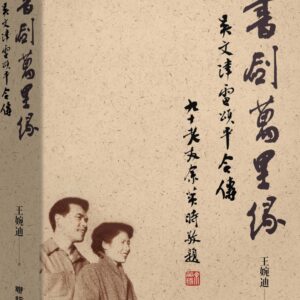
Cover of Wandi Wang's book

New Graduate Student Publication: Book on Eugene Wu and Song P’ing Lei

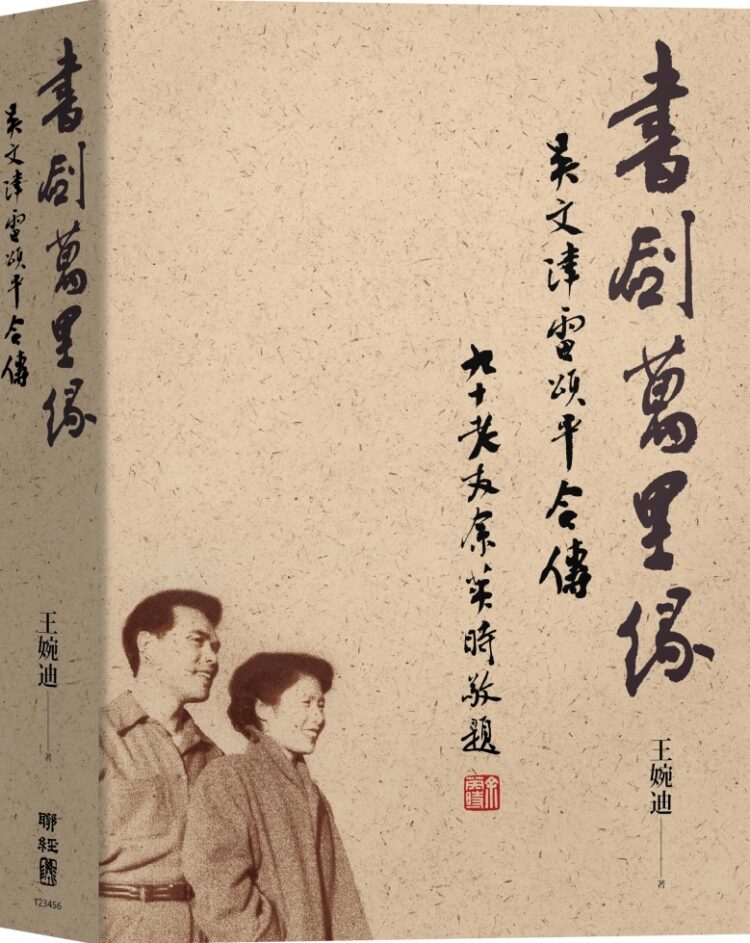
Cover of Wandi Wang's book

Congratulations to Wandi Wang, one of our stellar graduate students, on the publication of her book about Eugene Wen Chin Wu and his wife Song P’ing Lei. Wu was one of the pioneers who helped establish East Asian libraries in the United States after the Second World War.
See the description on Linking Publishing’s website for more information: https://www.linkingbooks.com.tw/LNB/book/Book.aspx?ID=178163&vs=pc.
Poster for lecture, "Digitizing the Tracks of Yu" by Dr. Ruth Mostern

“Digitizing the Tracks of Yu” Lecture with Dr. Ruth Mostern, Feb. 18, 2pm

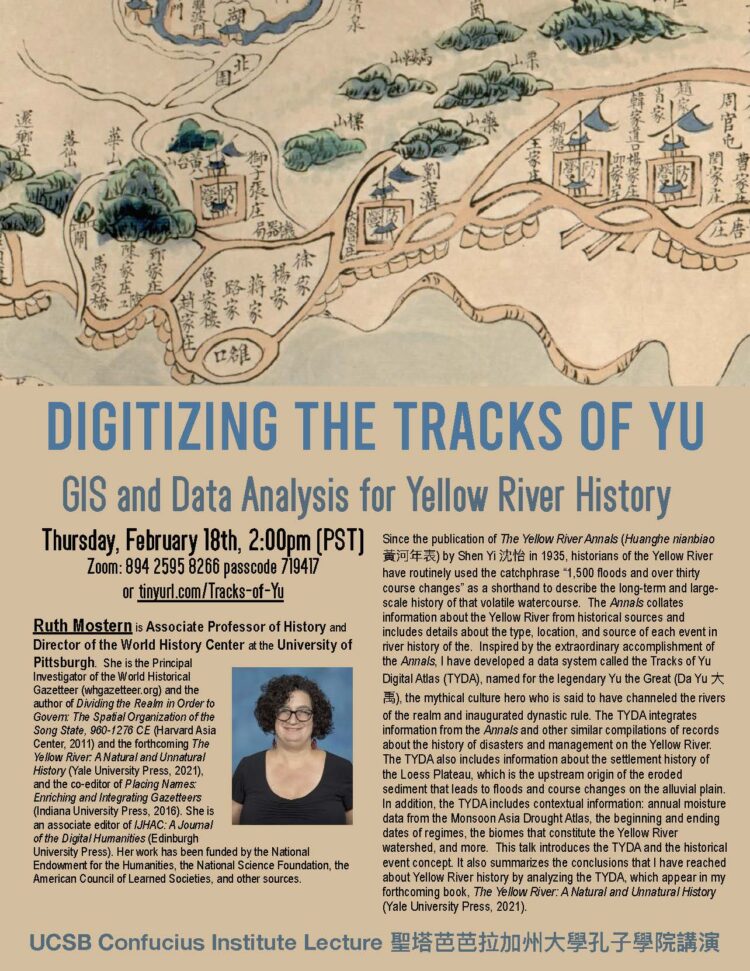
Poster for lecture
Please join us for a lecture with Dr. Ruth Mostern to learn about GIS and data analysis for Yellow River history.
“Digitizing the Tracks of Yu: GIS and Data Analysis for Yellow River History”
Thursday, February 18, 2021    2:00pm (PST)
tinyurl.com/Tracks-of-Yu (Zoom: 894 2595 8266 passcode: 719417)
Since the publication of The Yellow River Annals (Huanghe nianbiao 黃河年表) by Shen Yi 沈怡 in 1935, historians of the Yellow River have routinely used the catchphrase “1,500 floods and over thirty course changes” as a shorthand to describe the long-term and large-scale history of that volatile watercourse.  The Annals collates information about the Yellow River from historical sources and includes details about the type, location, and source of each event in river history of the.  Inspired by the extraordinary accomplishment of the Annals, I have developed a data system called the Tracks of Yu Digital Atlas (TYDA), named for the legendary Yu the Great (Da Yu 大禹), the mythical culture hero who is said to have channeled the rivers of the realm and inaugurated dynastic rule. The TYDA integrates information from the Annals and other similar compilations of records about the history of disasters and management on the Yellow River. The TYDA also includes information about the settlement history of the Loess Plateau, which is the upstream origin of the eroded sediment that leads to floods and course changes on the alluvial plain. In addition, the TYDA includes contextual information: annual moisture data from the Monsoon Asia Drought Atlas, the beginning and ending dates of regimes, the biomes that constitute the Yellow River watershed, and more.  This talk introduces the TYDA and the historical event concept. It also summarizes the conclusions that I have reached about Yellow River history by analyzing the TYDA, which appear in my forthcoming book, The Yellow River: A Natural and Unnatural History (Yale University Press, 2021).
Flyer for "Electric Design: Light, Labor, and Leisure in Prewar Japanese Advertising" featuring Gennifer Weisenfeld from Duke University on 2/24 at 4-5:30Pm

Inaugural Koichi Takashima Lecture: Gennifer Weisenfeld

Please join us for our Inaugural Koichi Takashima Lecture on Wednesday, Feb. 24 at 4:00 PM PST! Featuring the electrifying Gennifer Weisenfeld (Duke University) on “Electric Design: Light, Labor and Leisure in Prewar Japanese Advertising.”
This talk explores the industry’s important cultivation of a nascent consumer market for electrical goods in the prewar period, & the role of graphic design & advertising in aestheticizing, visualizing, & commodifying the seemingly transformative social powers of electric energy.
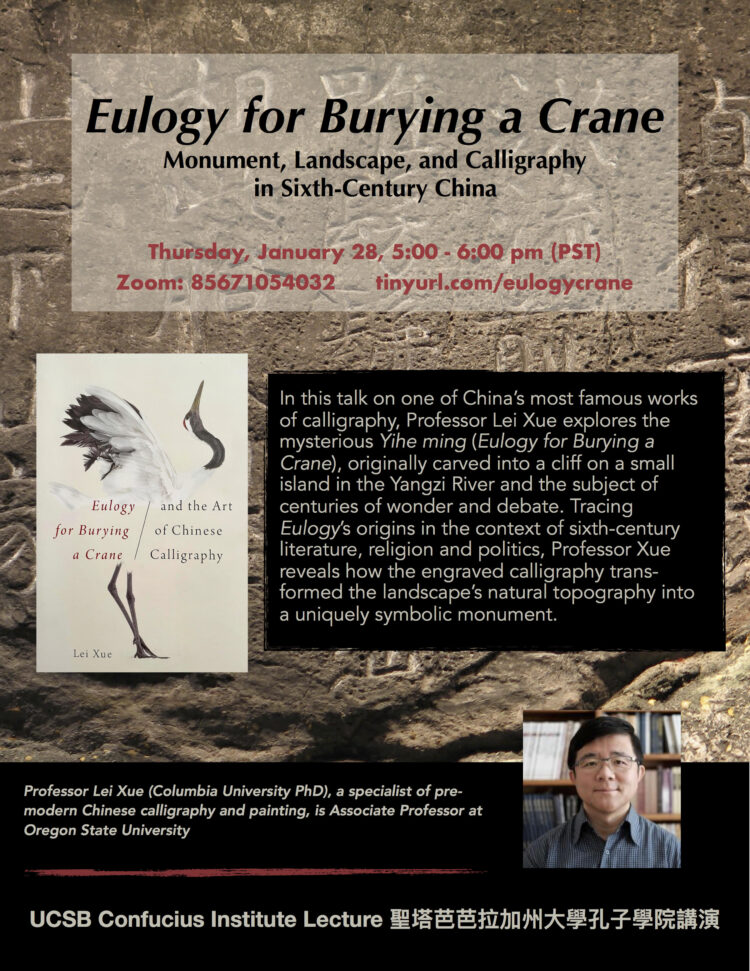
Flyer for "Eulogy for Burying a Crane: Monument, Landscape, and Calligraphy in Sixth Century China" featuring Professor Lei Xue on 1/28 from 5-6PM

Visiting Lecture on Chinese Calligraphy by Prof. Lei Xue

poster for professor xue's talk

On Thursday, January 28, 2021, at 5:00pm (Pacific Time) Prof. Lei Xue of Oregon State University will deliver a lecture on the mysterious Yihe ming 瘞鶴銘 (Eulogy for Burying a Crane) and its significance to the history of Chinese calligraphy. The talk is coordinated with Prof. Peter Sturman’s “Chinese Calligraphy” course (Chinese / Art History 134K) but open to all. Please join us via Zoom at tinyurl.com/eulogycrane.

The talk is sponsored by the UCSB Confucius Institute.

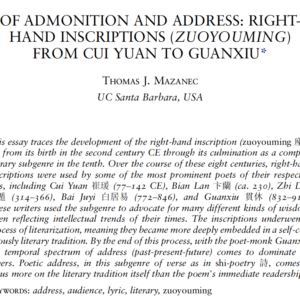
Essay excerpt from "Of Admonition and Address: Right-Hand Inscriptions (Zuoyouming) from CuiYuan to Guanxiu" by Thomas J. Mazanec

New faculty publication on poetic address (Thomas Mazanec)

Professor Thomas Mazanec‘s article on the topic of poetic address in medieval China has been published in the 38th issue of Tang Studies. It will be of interest not only to specialists in Chinese literature, but to anyone interested in lyric theory or the poetics of inscriptions.

“Of Admonition and Address: Right-Hand Inscriptions (Zuoyouming) from Cui Yuan to Guanxiu.” Tang Studies 38 (2020): 28–56. PDF.

Abstract

This essay traces the development of the right-hand inscription (zuoyouming 座右銘) from its birth in the second century CE through its culmination as a complex literary subgenre in the tenth. Over the course of these eight centuries, right-hand inscriptions were used by some of the most prominent poets of their respective eras, including Cui Yuan 崔瑗 (77–142 CE), Bian Lan 卞蘭 (ca. 230), Zhi Dun 支遁 (314–366), Bai Juyi 白居易 (772–846), and Guanxiu 貫休 (832–913). These writers used the subgenre to advocate for many different kinds of wisdom, often reflecting intellectual trends of their times. The inscriptions underwent a process of literarization, meaning they became more deeply embedded in a self-consciously literary tradition. By the end of this process, with the poet-monk Guanxiu, the temporal spectrum of address (past-present-future) comes to dominate the others. Poetic address, in this subgenre of verse as in shi-poetry 詩, comes to focus more on the literary tradition itself than the poem’s immediate readership.

Professor Mazanec has also written about the story behind the article on his personal website. See here for more: http://tommazanec.com/blog/2021/01/20/article-on-poetic-address-published-in-tang-studies/.


Korea Foundation logo

Department Awarded Korea Foundation Grant To Help Establish Korean Studies Professorship

We are thrilled to announce that the Department has been awarded a five-year grant from the Korea Foundation to support the establishment of a tenure-track professorship in Korean Studies! This new position will help expand our growing offerings in Korean, including both language and content courses.

More details to follow in the coming year.