The placement test for Korean 4 will take place on September 26th at 2pm.
Please contact Wona Lee at wonalee@ucsb,edu to sign up for the test.
The placement test for Korean 4 will take place on September 26th at 2pm.
Please contact Wona Lee at wonalee@ucsb,edu to sign up for the test.
The Department of East Asian Languages and Cultural Studies at the University of California, Santa Barbara, invites applications for the position of Visiting Assistant Professor for the 2019-2020 academic year.
We seek applicants with expertise in Japanese literature from the Meiji Period to the present and Japanese film from a cultural studies perspective. We seek candidates with active research agendas who will participate in research activities in the department and be available to graduate students with relevant topics. The candidate will be expected to teach five courses related to their expertise and to advanced language training: Survey of Modern Japanese Literature, Topics in Modern Japanese Literature (topics to be chosen by the candidate), Japanese Cinema, and two classes of advanced Japanese readings (readings to be chosen by the candidate) or one class of advanced Japanese readings plus a second class to be determined. The candidate would also be asked to contribute to department programs by planning events related to their expertise, such as film showings and visiting speakers.
Minimum requirements include a Ph.D. in a relevant field, specialization in modern and contemporary Japanese literature and cinema, and high-level Japanese language ability. Salary is based on UC salary scales and depends on qualifications. To ensure full consideration, please submit a cover letter, curriculum vitae, a statement of research, a statement of teaching experience, and arrange for three letters of recommendation sent to UC Recruit https://recruit.ap.ucsb.edu/JPF01499 . The position will remain open until filled, but complete applications received by May 13, 2019 will receive full review.
The Department is especially interested in candidates who can contribute to the diversity and excellence of the academic community through research, teaching, and service as appropriate to the position. Inquiries may be directed to Katherine Saltzman-Li, Chair of the Department of East Asian Languages and Cultural Studies, at ksaltzli@eastasian.ucsb.edu. For more information on the department, please visit our website at: https://www.eastasian.ucsb.edu.
The University of California is an Equal Opportunity/Affirmative Action Employer and all qualified applicants will receive consideration for employment without regard to race, color, religion, sex, sexual orientation, gender identity, national origin, disability status, protected veteran status, or any other characteristic protected by law.
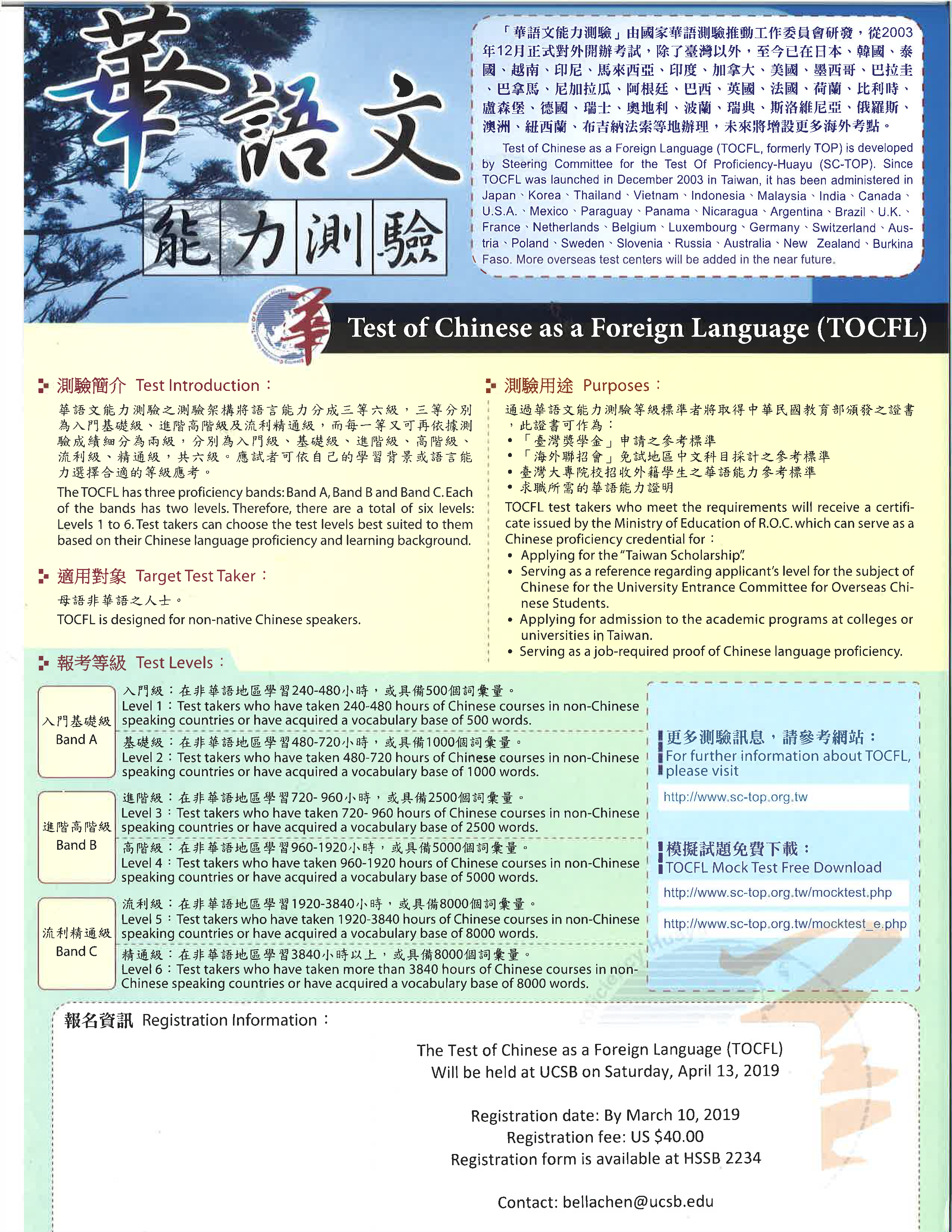
The Test of Chinese as a Foreign Language (TOCFL) will be held at UCSB on Saturday, April 13, 2019 at HSSB 2206
Registration date: By March 10, 2019
Registration fee: US $40.00
Registration form is available at HSSB 2234
Contact: bellachen@ucsb.edu
Further information about TOCFL: https://tocfl.edu.tw/
The EALCS 2018 Newsletter is now available for download. We hope you enjoy!
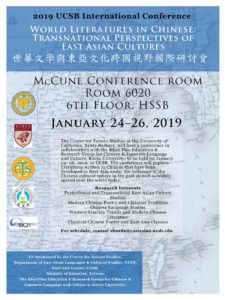
Date: January 24-26
Place: HSSB, 6020 (6th floor)
The Center for Taiwan Studies at the University of California, Santa Barbara, will host a conference in collaboration with the BK21 Plus Education & Research Group for Chinese & Japanese Language and Culture, Korea University, to be held on January 24-26, 2019, at UCSB. The conference will explore literatures written in Chinese that have developed in East Asia and under the influences of the Chinese cultural sphere in the past as well as widely spread over the world today since the last century.
Speaker: Kondo Aisuke
Date: Thursday, January 31
Time: 5:00 pm
Place: HSSB 1151
Please join the Department of Theater and Dance for a viewing of work by Japanese artist Kondo Aisuke, followed by a Q&A with the artist.
Born and raised in Japan and currently based in Germany, Kondo explores questions of belonging, identity, memory, and history across a variety of media, from collage and gallery installation to video and performance. In his current Matter and Memory series (2017-present), Kondo retraces his great grandfather’s life as an immigrant in the US from his arrival in the early 1900s until his incarceration in the Topaz internment camp during World War II.
For more information, click here.