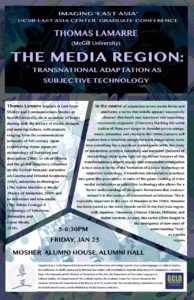
The Media Region: Transnational Adaptations

Speaker: Professor Thomas Lamarre (McGill University)
Date: Friday, January 25
Time: 5:00-6:30 pm
Place: Mosher Alumni House, Alumni Hall

In the course of adaptation across media forms and platforms, a series that initially appears ‘excessively obvious’ (Bordwell) may transform into something ‘excessively enigmatic’ (Elsaesser). Tracking the serialization of Hana yori dango or Hanadan across manga, music, animation, and cinema in the 1990s, Lamarre will explore how a relatively straightforward manga series turns into something like a puzzle or a mind game. While the study of production (creative industries) and narration (patterns of storytelling) sheds some light on the formal features of this transformation, Lamarre argues that the transmedial serialization is best seen in terms of the formation of a social technology or subjective technology. It transforms interpretive practices into game-like procedures, or rules of the game. Looking at trans-medial serialization as subjective technology also allows for a better understanding of the power formations that coalesce around it in the context of transnational serialization. This is especially important in the case of Hanadan in the 2000s. Hanadan has been touted as the most remade series in the East Asia region, with Japanese, Taiwanese, Chinese, Korean, Philippine, and Indian versions. As such, this series offers insights in the emergence of new ways of understanding “Asia” as a media region.
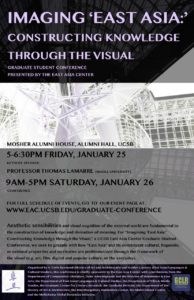
Imaging ‘East Asia:’ Constructing Knowledge Through the Visual

Join us this Friday and Saturday for the East Asia Center Graduate Student Conference!

Friday, January 25, 5:00-6:30: Professor Thomas Lamarre (McGill University) Keynote Speech, Mosher Alumni House

Saturday, January 26, 9:00 a.m. to 5:00 p.m.: Graduate Student Conference, Mosher Alumni House

Aesthetic sensibilities and visual cognition of the external world are fundamental to the construction of knowledge and divination of meaning. For “Imagining ‘East Asia:’ Constructing Knowledge through the Visual,” a UCSB East Asia Center Graduate Student Conference, we seek proposals that grapple with how “East Asia” and its constituent cultural, linguistic, or national properties and territories are problematized through the framework of the visual (e.g. art, film, digital and popular culture, or the everyday). Visual culture constructs and is constructed by assumptions about the world. How one reads visual culture is determined on at least two fronts—first, by the artist/producer through choices of subject, style, and genre, among others and, second, by the audience’s worldviews, biases, and dispositions. Given the inherent subjectivity of visual cognition, we as historians, art historians, anthropologists, religion, film, and literature scholars are forever conscious of alternative readings and wary of misrepresentations.


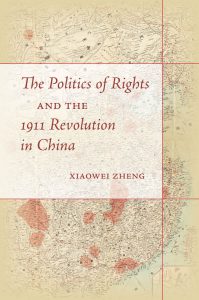
Book Launch: The Politics of Rights and the 1911 Revolution in China

Date: Wednesday, October 17

Time: 5:00 pm

Place: HSSB 6020 McCune Room

Please join the Department of History, the Department of East Asian Languages and Cultural Studies and the UCSB Confucius Institute to celebrate the publication of The Politics of Rights and the 1911 Revolution in China by Professor Xiaowei Zheng (Stanford University Press, 2018). We will be celebrating this accomplishment on Wednesday October 17 from 5-7 pm in the McCune Room (HSSB 6020). Prof Matthew Sommer (Stanford) and Prof. Tony Barbieri-Low (UCSB) will offer commentary on the book’s significance and contributions.  A reception will follow. Please read “China’s 1911 Revolution” in today’s Current here.

From the Dragon’s Mouth: A Life in Translation

From the Dragon’s Mouth: A Life in Translation
Speaker: Brian Holton, Chinese-Scots and Chinese-English literary translator
Date: Tuesday, October 9
Time: 5:00pm
Place: HSSB 4080, UC Santa Barbara
Brian Holton is a poet and prize-winning translator of Chinese poetry. Famed for his renditions of contemporary poet Yang Lian 楊煉 into English, he is also the the world’s only translator of Classical Chinese into Scots. Join us for an evening in which Brian discusses the art and practice of translation, the experience of working in a minority language like Scots, and his life growing up between Nigeria and Scotland, immersed in a myriad of languages.