Event: 2026 Symposium on Asian Indigeneity

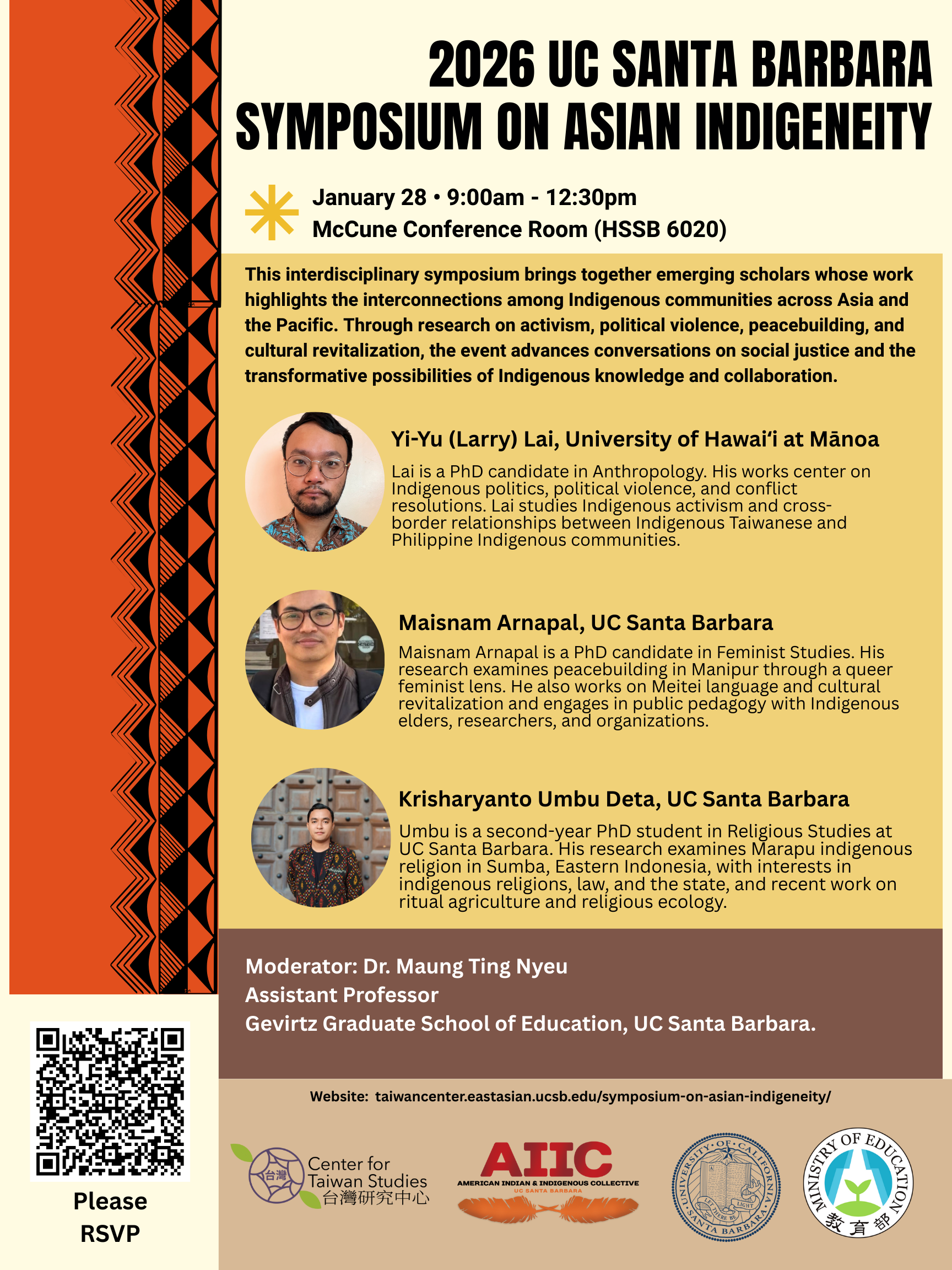
2026 Symposium on Asian Indigeneity 

(Hosted by the Center for Taiwan Studies and American Indian & Indigenous Studies)

This interdisciplinary symposium brings together emerging scholars whose work highlights the interconnections among Indigenous communities across Asia and the Pacific. Through research on activism, political violence, peacebuilding, and cultural revitalization, the event advances conversations on social justice and the transformative possibilities of Indigenous knowledge and collaboration (RSVP).
 
Date: January 28, 2026
Time: 9:00 AM – 12:30 PM

Speakers
• Yi-Yu (Larry) Lai (University of Hawaiʻi at Mānoa)
• Maisnam Arnapal (UC Santa Barbara)
• Krisharyanto Umbu Deta (UC Santa Barbara)

Moderator
Dr. Maung Ting Nyeu (Gevirtz Graduate School of Education, UCSB)

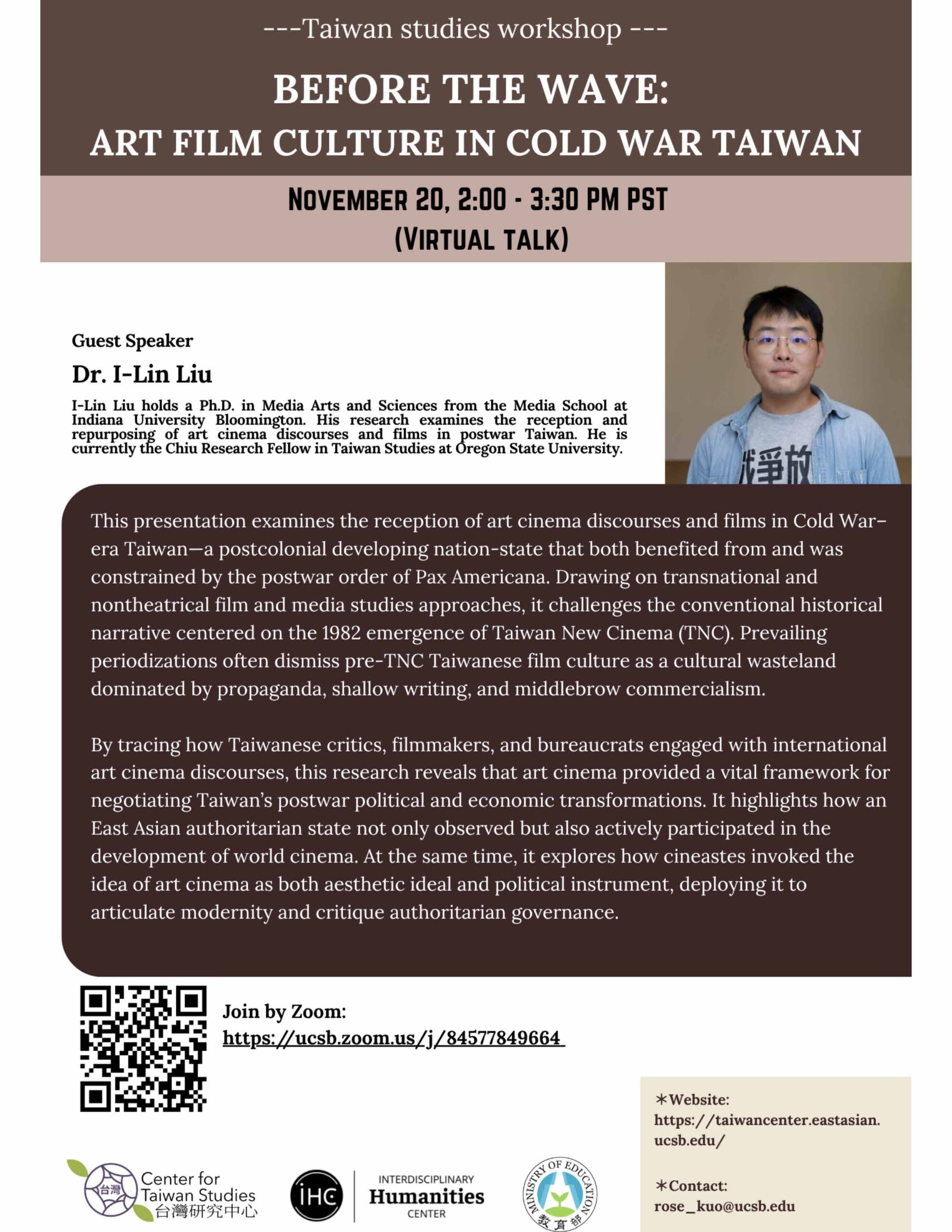
11/20: Before the Wave: Art Film Culture in Cold War Taiwan

Title: Before the Wave: Art Film Culture in Cold War Taiwan

Speaker: Dr. I-Lin Liu (Chiu Research Fellow in Taiwan Studies, Oregon State University)

Time: November 20 (Thursday), 2:00 – 3:30 PM PST

Zoom Information: https://ucsb.zoom.us/j/84577849664


This presentation examines the reception of art cinema discourses and films in Cold War–era Taiwan—a postcolonial developing nation-state that both benefited from and was constrained by the postwar order of Pax Americana. Drawing on transnational and nontheatrical film and media studies approaches, it challenges the conventional historical narrative centered on the 1982 emergence of Taiwan New Cinema (TNC). Prevailing periodizations often dismiss pre-TNC Taiwanese film culture as a cultural wasteland dominated by propaganda, shallow writing, and middlebrow commercialism.


By tracing how Taiwanese critics, filmmakers, and bureaucrats engaged with international art cinema discourses, this research reveals that art cinema provided a vital framework for negotiating Taiwan’s postwar political and economic transformations. It highlights how an East Asian authoritarian state not only observed but also actively participated in the development of world cinema. At the same time, it explores how cineastes invoked the idea of art cinema as both aesthetic ideal and political instrument, deploying it to articulate modernity and critique authoritarian governance.


For more information, please see: https://taiwancenter.eastasian.ucsb.edu/cts-salon/

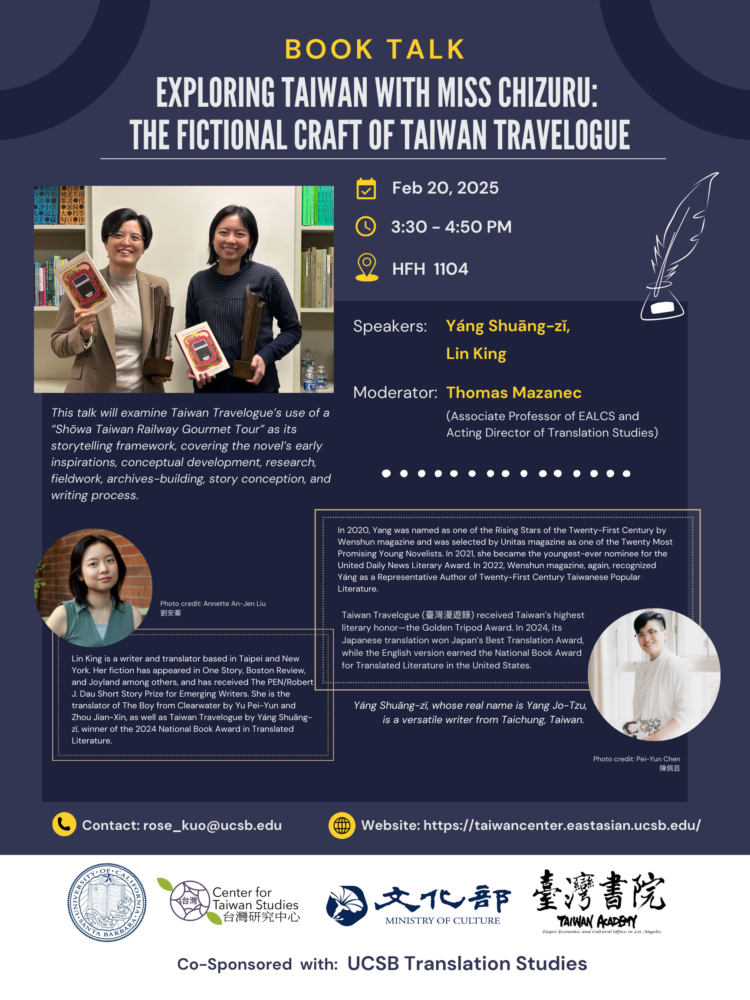
Exploring Taiwan with Miss Chizuru: The Fictional Craft of Taiwan Travelogue

Date: February 20, 2025
Time:
3:30–4:50pm
Location: 
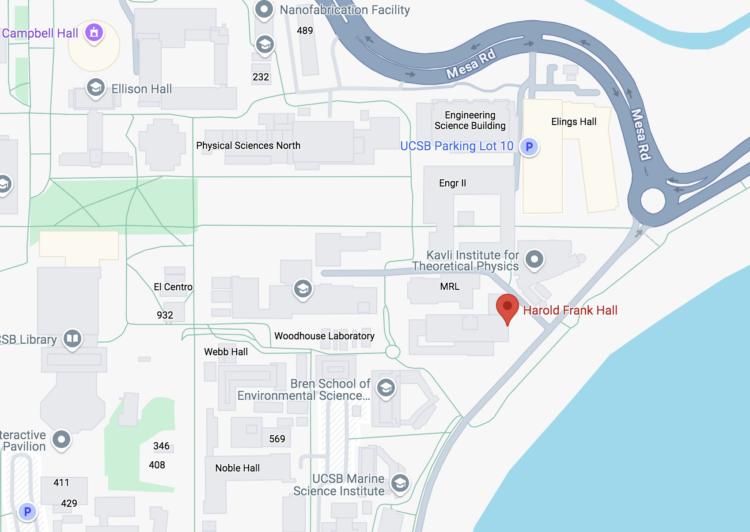
Harold Frank Hall 1104

Description:
How can a Taiwanese novel incorporate historical materials from its decades under
Japanese colonial rule? How does two women’s travelogue become a work of fiction?
This talk will examine Taiwan Travelogue’s use of a “Shōwa Taiwan Railway
Gourmet Tour” as its storytelling framework, covering the novel’s early inspirations,
conceptual development, research, fieldwork, archives-building, story conception, and
writing process.

How can historical documents from the Japanese colonial period be material for novel
writing? How do women’s travels in history become the subject of fictional
storytelling? Using Taiwan Travelogue as an example, this lecture will cover the
journey of creating the “Shōwa period Taiwan Railway Gourmet Tour,” from initial
inspiration, concept development, research, and fieldwork to organization, story
structure, and the final writing process.

The Author: Yáng Shuang-zi
Yáng Shuāng-zǐ, whose real name is Yang Jo-Tzu, is a versatile writer from Taichung,
Taiwan. She dabbles in various forms, including fiction, essays, manga scripts, and
literary criticism.

In 2020, she was named one of the Rising Stars of the Twenty-First Century by
Wenshun magazine and was selected by Unitas magazine as one of the Twenty Most
Promising Young Novelists. In 2021, she became the youngest-ever nominee for the
United Daily News Literary Award. In 2022, Wenshun magazine again recognized
Yáng as a Representative Author of Twenty-First Century Taiwanese Popular
Literature.

Her notable works include the novel The Season When Flowers Bloom (花開時節) in
2017, the short story collection Blossoming Girls of Gorgeous Island (花開少女華麗
島) in 2018, and the novel Taiwan Travelogue (臺灣漫遊錄) in 2020. Taiwan
Travelogue received Taiwan’s highest literary honor—the Golden Tripod Award. In
2024, its Japanese translation won Japan’s Best Translation Award, while the English
version earned the National Book Award for Translated Literature in the United
States.
CARE: Archives & Bodies Reading Group

We’re forwarding information about a new reading group initiative, “The Archives & Bodies Reading Group.” It critically examines and reimagines the roles archives play in humanities research and explores intersections between archival practices, embodiment, and marginalized histories – topics that may be of interest to many in our research community. It is part of an event series organized by the Collective for Archival Research of Embodiment (CARE), a UC-wide multicampus graduate student working group, which includes our colleagues Yiming, Uudam (RG ST), Diandian (MUSIC), Tinghao (FAMST), and other UC grad students. Other CARE events include archival writing workshops and an end-of-year performative exhibition. For more information, please take a look at the attached flyer and reach out to the contact people.

The inaugural session details are below:

Theme: “Mnemonic Bodies: Affective Archives, Memory, and Care”
Date&Time: Saturday, November 9, 6:30 PM (PST)
Platform: Zoom

Reading Materials:

  • Jacques Derrida, “Archive Fever: A Freudian Impression”
  • Ann Laura Stoler, Carnal Knowledge and Imperial Power (chs. 1&4)
  • Diana Taylor, The Archive and the Repertoire (ch. 3)

Registration: https://tinyurl.com/ndke3vn2
Access to readings: https://tinyurl.com/pdupmhph

This open-to-all reading group is organized by the Collective for Archival Research of Embodiment (CARE), a UC-wide graduate student working group. It’s sponsored by the UC Humanities Research Institute, the Interdisciplinary Humanities Center, and the Department of East Asian Languages and Cultural Studies at UCSB.

For questions, please contact: Yiming Ma (UCSB): yimingma@ucsb.edu; Tianyun Hua (UCD): tyhua@ucdavis.edu