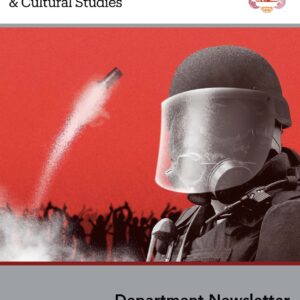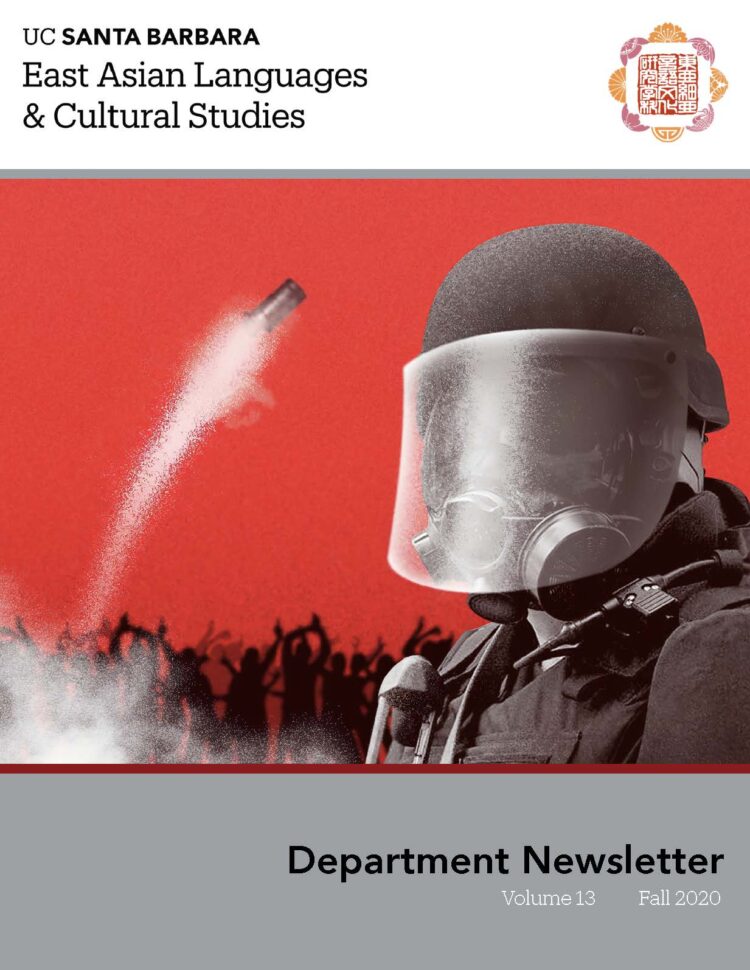
Cover of the fall 2020 newsletter. Features a person in riot gear standing in front of a vibrant red background, in which a canister of tear gas is vaulting into the air.

Fall 2020 Newsletter Released

Cover of the fall 2020 newsletter. Features a person in riot gear standing in front of a vibrant red background, in which a canister of tear gas is vaulting into the air.

We are pleased to announce the publication of our Fall 2020 Newsletter (vol. 13). In addition to reports from the programs and centers that are associated with the Department, we are proud to present two new faculty members, reflections on major academic and artistic events, our wonderful undergraduate and graduate students’ achievements, and our faculty members’ accomplishments along with numerous other contributions.

Call for Papers: The Worst Chinese Poetry: A Virtual Workshop

The Worst Chinese Poetry: A Virtual Workshop
April 5–9, 2021

Organized by Thomas Mazanec, Xiaorong Li, and Hangping Xu

Call for Papers

Good poems are all alike, but every bad poem is bad in its own way. Poems may fail according to aesthetic, formal, political, social, moral, and other criteria. There are failures of innovation and imitation, of quantity and quality, of ambition and cowardice. The purpose of this virtual workshop is to explore what was thought to be the very worst poetry written in Chinese and to understand why it was regarded so poorly. We want to know who considered it bad, and according to what criteria. By examining the “worst” poetry and the harshest judgments on it from antiquity to the present, we hope to offer a literary history as seen through failure.

The workshop will introduce and discuss primary texts that address the question of why a poem might be called “bad.” Participants are invited to submit up to 10 pages (inclusive of English translation) of “bad” Chinese poetry or critical writings on it from any historical period, accompanied by 5–10 pages (1250–2500 words) of critical introduction. Texts should highlight important moments in the history of bad poetry and how they relate to aesthetic, political, social, and conceptual norms. During the workshop, participants will meet on Zoom for several half-days to discuss the contributions.

Our definition of badness is broad. The awkward, the ugly, the wild, the immoral, the vulgar, the boring, the didactic, the unusual—all may be considered bad. Poetry that’s good in one context is often bad in another. Some topics that participants may wish to consider addressing include (but are not limited to):

  • canon formation
  • genre theory
  • religious poetry
  • misinterpreted poetry
  • translated poetry
  • internet poetry
  • imitative or intertextual poetry
  • licentious or decadent poetry
  • poetry by political toadys or turncoats
  • poetry by emperors and governors (looking at you, Qianlong!)
  • poetry by non-Chinese or diaspora poets
  • poetry by women, workers, merchants, monks, and all varieties of non-literati
  • poetry in novels, plays, stories, and other kinds of literary works

Contributions will be collected, reviewed, and edited for publication as part of The Worst Chinese Poetry: A Critical Anthology. Abstracts of up to 250 words describing a Chinese text and its relevance to bad poetry are due by October 15, 2020. Full contributions will be due January 31, 2021. The workshop will convene the week of April 5–9, 2021.
Inquiries and proposals may be submitted to the organizers, Thomas Mazanec (mazanec@ucsb.edu), Xiaorong Li (lixiaor@ucsb.edu), and Hangping Xu (hangping@ucsb.edu).

Congratulations to Our Graduate Student Fellowship, Grant, and Award Recipients

During the 2019-2020 academic year, our graduate students enjoyed great success winning awards, fellowships, and grants. We are truly proud of their academic achievements and offer them our warmest congratulations! 

Carl Gabrielson, a Ph.D. candidate researching on contemporary Japan, was awarded a number of grants and fellowships: 1. UCSB Graduate Scholars Program Mentoring Grant; 2. UCSB Interdisciplinary Humanities Center Mellon Engaging Humanities Fellowship; 3. Japan Society for the Promotion of Science Short-Term Fellowship for Research in Japan (Project Title: “Orienting the Troops: Militarizing the Interpersonal in the U.S.-Japan Alliance”); and 4. Graduate Division Dissertation Fellowship.

Elizabeth Kataoka, a Ph.D. candidate specializing on modern Japan, was awarded a Fulbright Open Study Research Award and a 2020 Japan Foundation/UCSB Graduate Division Research Accelerator Award. She will continue researching for her dissertation project on “Assimilating Identity? Education, Epistemologies, and Ainu Consciousness in the Twentieth Century.”

Joseph Lovell, a Ph.D. candidate working on modern China, was awarded a highly competitive doctoral fellowship by the Chiang Ching-kuo Foundation. Joe’s dissertation project is titled “The Maoist Soundscape: The Usage and Reception of Amplified Sound in the People’s Republic of China, 1949-1976.”

Yiming Ma, a first year Ph.D. student, won a 2020 Japan Foundation/UCSB Graduate Division Research Accelerator Award, which will enable him to conduct preparatory archival research for his dissertation project on underground trans-war networks of Japanese and Chinese leftwing intellectuals and artists in Tokyo and Shanghai.

Keita Moore, a Ph.D. candidate working on contemporary Japan, received Japan Society for the Promotion of the Sciences (JSPS) Doctoral Fellowship for Research in Japan for his dissertation project titled “Grand Designs: Videogames, Societal Time, and Developer Agency in Contemporary Japan.” In addition, Keita also won the 2020 Koichi Takashima Graduate Research Award.

Kaitlyn Ugoretz, a Ph.D. candidate working on Shinto, received a number of important grants. She was awarded the Japan Foundation Doctoral Research Fellowship, a Social Sciences Research Council International Dissertation Research Fellowship (SSRC-IDRF), and a 2020 Japan Foundation/UCSB Graduate Division Research Accelerator Award for her dissertation project, “World-Wide Shinto: The Globalization of ‘Japanese’ Religion.” In addition, she received a GSA Excellence in Teaching award and is currently in the final stage of consideration for a Wenner-Gren Dissertation Fieldwork Grant.

Congratulations, all!

2019 Department Newsletter Release

The 2019 Department newsletter is now available for download. Though delayed due to the pandemic, we are excited to tell you about many of the wonderful achievements of our students, alumni, faculty, staff, and programs.

2019 UCSB EALCS Newsletter Cover
Learn more about department activities in our newsletter.

Table of contents:

  • Words From the Chair
  • Chinese Language Program
  • Japanese Language Program
  • East Asia Center
  • In Her Own Words: Professor Xiaorong Li on Her New Book
  • Confucius Institute
  • The Writ of the Three Sovereigns by Professor Dominic Steavu
  • 2018 Fall Workshop and 10th Anniversary of Chinese Language Teachers’ Association of Southern California (CLTA-SC)
  • Talking with Patrick Laboon (MA in 2016)
  • Talking with Allison Visconti (MA in 2018)
  • Faculty Activities
  • Center for Taiwan Studies