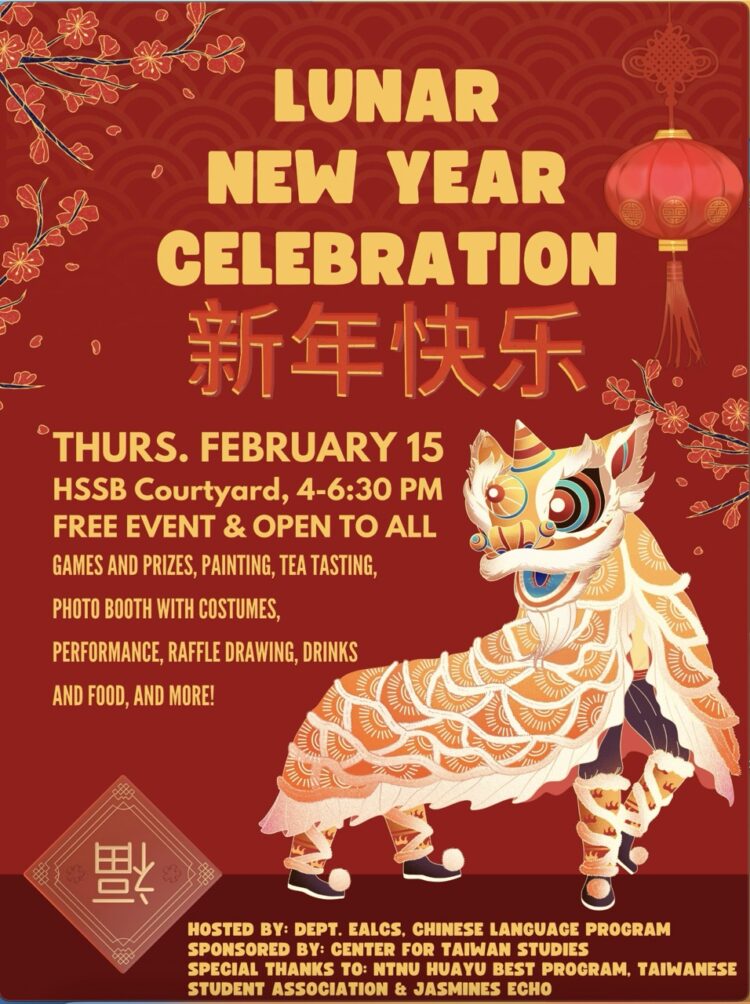
Banner for "Lunar New Year Celebration"

Lunar New Year Celebration on 2/15


Please join us this Thursday, February 15, to celebrate Lunar New Year with the Chinese Language Program. There will be games and prizes, painting, tea tasting, a photo booth with costumes, performances, raffle drawings, drinks and food, and more!

Date: Thursday, February 15

Time: 4:00–6:30pm

Place: HSSB Courtyard

Hosted by the Chinese Language Program and sponsored by the Center for Taiwan Studies. Special thanks to NTNU Huayu Best Program, the Taiwanese Student Assocation, and Jasmines Echo.

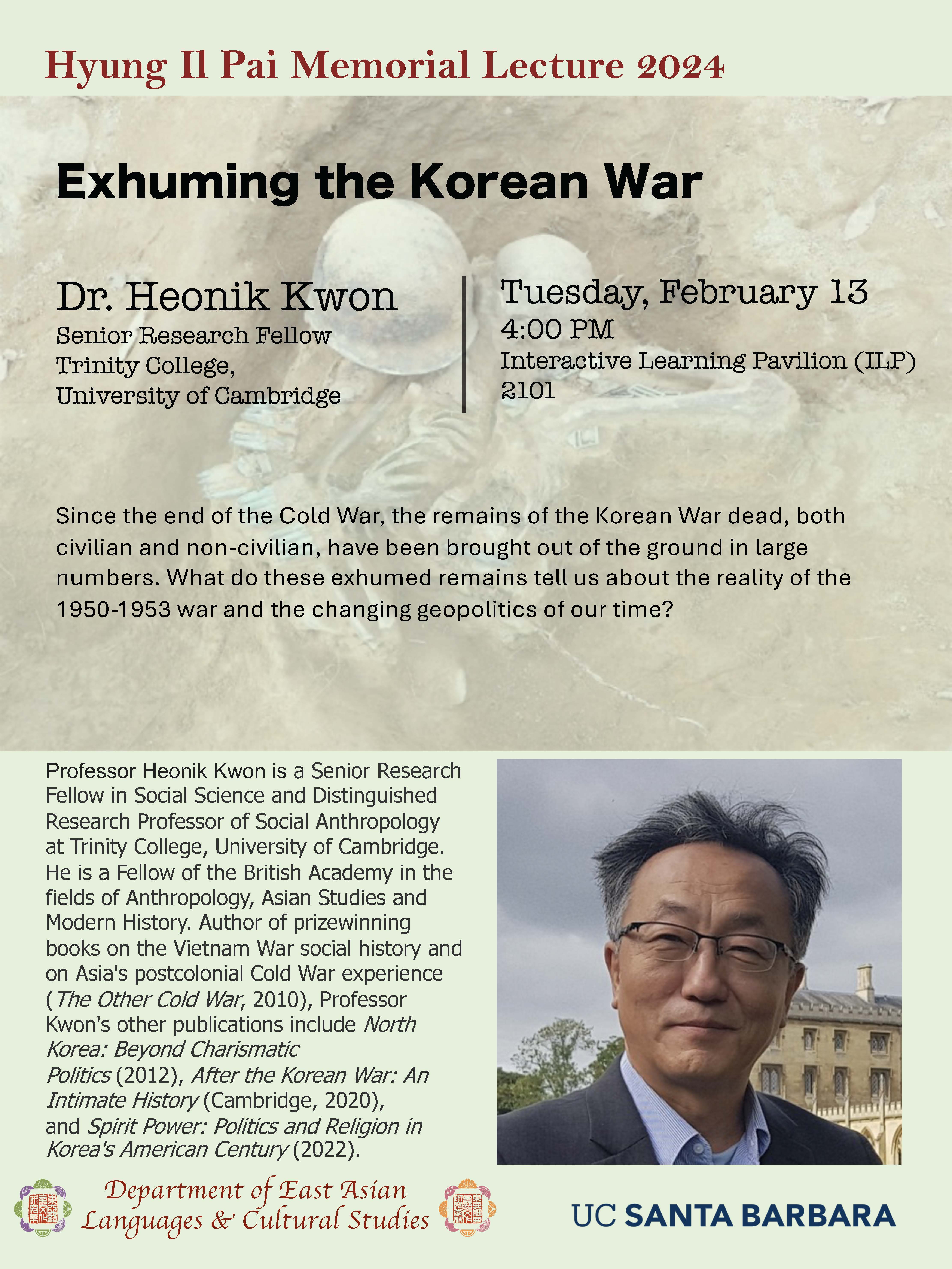
pile of excavated bones next to ammunition.

Hyung Il Pai Memorial Lecture 2024: Heonik Kwon, “Exhuming the Korean War,” 2/13, 4pm

Please join us for the 2024 Hyung Il Pai Memorial Lecture, by Dr. Heonik Kwon of Cambridge University, titled, “Exhuming the Korean War.”

Date: Tuesday, February 13
Time: 4:00 PM
Location: Interactive Learning Pavilion (ILP) 2101

Abstract:
Since the end of the Cold War, the remains of the Korean War dead, both civilian and non-civilian, have been brought out of the ground in large numbers. What do these exhumed remains tell us about the reality of the 1950-1953 war and the changing geopolitics of our time?

Speaker:
Professor Heonik Kwon is a Senior Research Fellow in Social Science and Distinguished Research Professor of Social Anthropology at Trinity College, University of Cambridge. He is a Fellow of the British Academy in the fields of Anthropology, Asian Studies and Modern History. Author of prizewinning books on the Vietnam War social history and on Asia’s postcolonial Cold War experience (The Other Cold War, 2010), Professor Kwon’s other publications include North Korea: Beyond Charismatic Politics (2012), After the Korean War: An Intimate History (Cambridge, 2020), and Spirit Power: Politics and Religion in Korea’s American Century (2022).

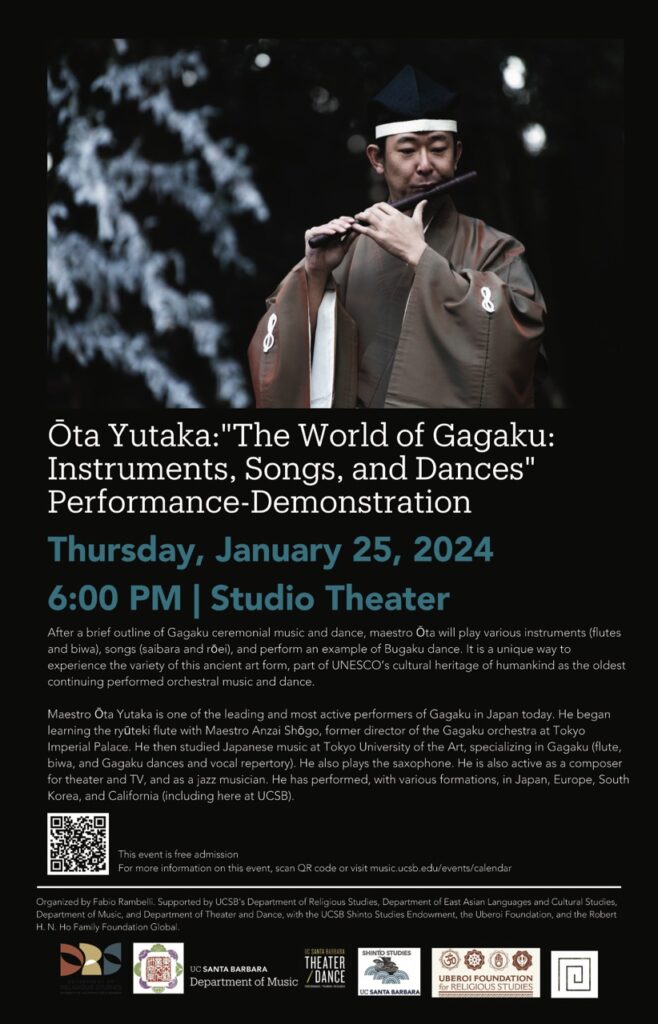
Lecture and Concert with Gagaku master musician Ōta Yutaka on January 24-25

Lecture and Concert with Gagaku master musician Ōta Yutaka on January 24-25.

Maestro Ōta Yutaka is one of the leading and most active performers of Gagaku in Japan today. He began learning the ryūteki flute with Maestro Anzai Shōgo, former director of the Gagaku orchestra at Tokyo Imperial Palace. He then studied Japanese music at Tokyo University of the Art, specializing in Gagaku (flute, biwa, and Gagaku dances and vocal repertory). He also plays the saxophone. He is also active as a composer for theater and TV, and as a jazz musician. He has performed, with various formations, in Japan, Europe, South Korea, and California (including here at UCSB).

Ōta Yutaka Lecture
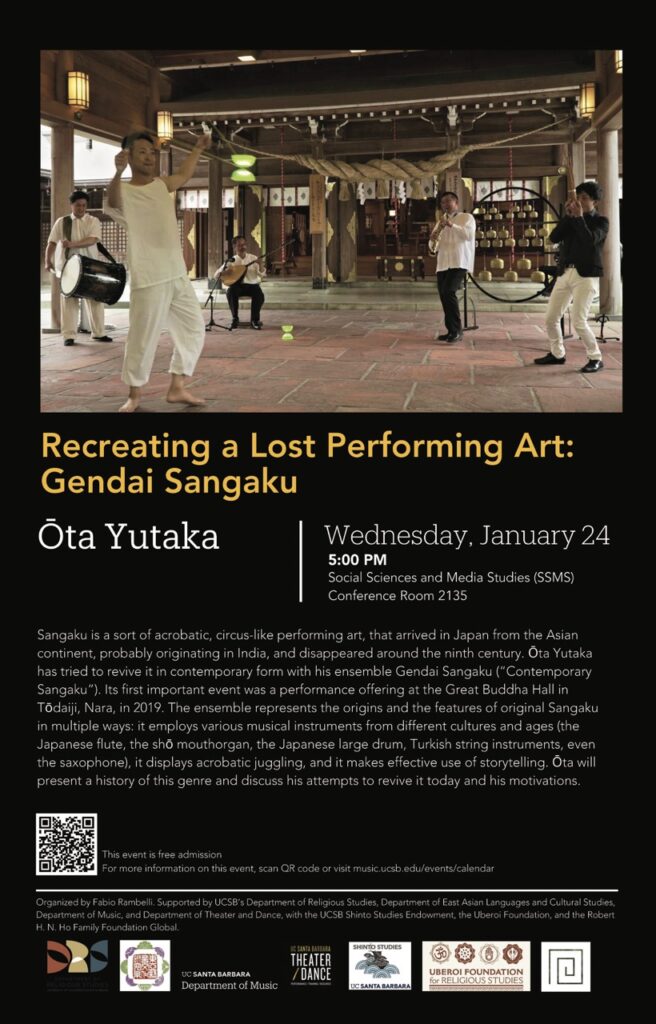
Recreating a Lost Performing Art: Gendai Sangaku

Wednesday, January 24, 2024 at 5:00 pm
Social Sciences and Media Studies (SSMS) Building, Conference Room 2135

Sangaku is a sort of acrobatic, circus-like performing art that arrived in Japan from the Asian continent, probably originating in India, and disappeared around the ninth century. Ōta Yutaka has tried to revive it in contemporary form with his ensemble Gendai Sangaku (“Contemporary Sangaku”). Its first important event was a performance offering at the Great Buddha Hall in Tōdaiji, Nara, in 2019. The ensemble represents the origins and the features of original Sangaku in multiple ways: it employs various musical instruments from different cultures and ages (the Japanese flute, the shō mouthorgan, the Japanese large drum, Turkish string instruments, even the saxophone), it displays acrobatic juggling, and it makes effective use of storytelling. Ōta will present a history of this genre and discuss his attempts to revive it today and his motivations.

Organized by Fabio Rambelli. Supported by UCSB’s Department of Religious Studies, Department of East Asian Languages and Cultural Studies, Department of Music, and Department of Theater and Dance, with support from the UCSB Shinto Studies Endowment, the Uberoi Foundation, and the Robert H. N. Ho Family Foundation Global.

Ōta Yutaka
Performance-Demonstration
The World of Gagaku: Instruments, Songs, and Dances

After a brief outline of Gagaku ceremonial music and dance, maestro Ōta will play musical instruments (flutes and biwa), songs (saibara and rōei), and perform an example of Bugaku dance. It is a unique way to experience the variety of this ancient art form, recognized by UNESCO as part of the cultural heritage of humankind as the oldest continuously performed orchestral music and dance.

Thursday, January 25, 2024 at 6:00 pm
Theater Studio (next to Hatlen Theater)

Organized by Fabio Rambelli. Supported by UCSB’s Department of Religious Studies, Department of East Asian Languages and Cultural Studies, Department of Music, and Department of Theater and Dance, with support from the UCSB Shinto Studies Endowment, the Uberoi Foundation, and the Robert H. N. Ho Family Foundation Global.
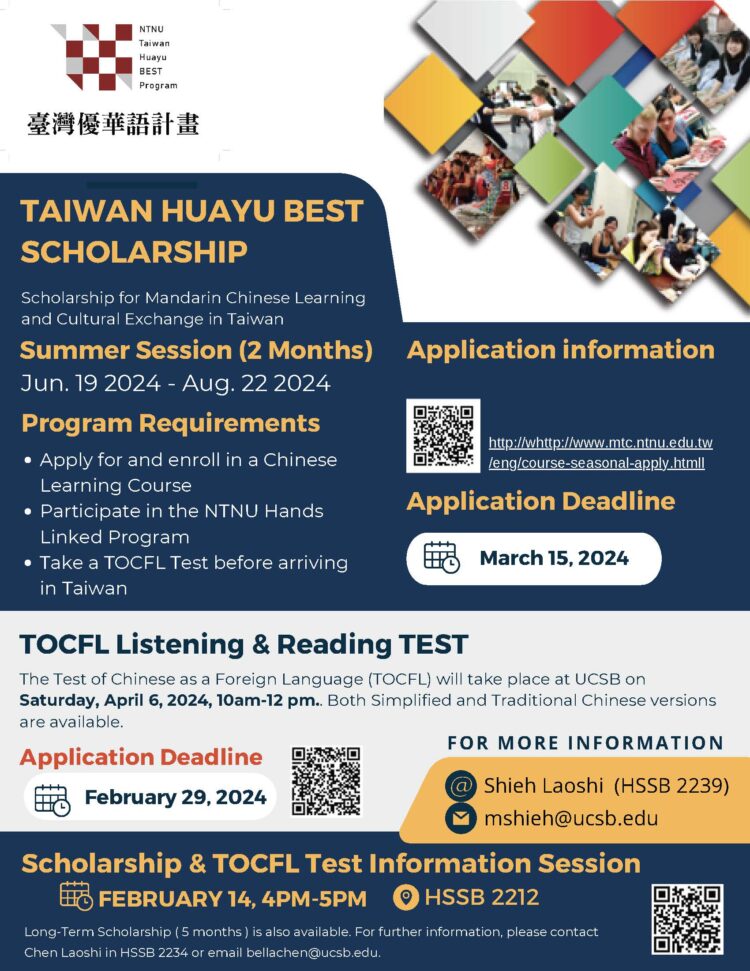
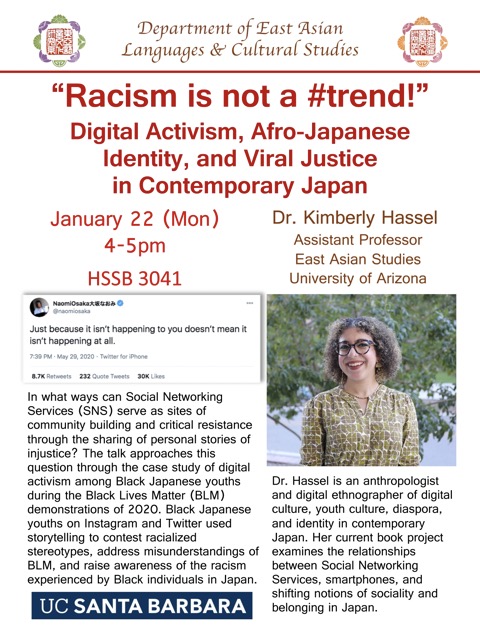
Flyer for "Racism is not a #trend!: Digital Activism, Afro-Japanese Identity, and Viral Justice Contemporary Japan" by Dr. Kimberly Hassel on 1/22 from 4-5PM in HSSB 3041

Talk: Kimberly Hassel, “Racism is not a #trend!” Digital Activism, Afro-Japanese Identity, and Viral Justice in Contemporary Japan

Time: January 22 (Mon), 4-5pm
Place: HSSB 3041

Join us on January 22 (Mon), 4-5pm, in HSSB 3041, to hear a talk from Dr. Kimberly Hassel, assistant professor in the Department of East Asian Studies at the University of Arizona, on “‘Racism is not a #trend!’ Digital Activism, Afro-Japanese Identity, and Viral Justice in Contemporary Japan.”

In what ways can Social Networking Services (SNS) serve as sites of community building and critical resistance through the sharing of personal stories of injustice? The talk approaches this question through the case study of digital activism among Black Japanese youths during the Black Lives Matter (BLM) demonstrations of 2020. Black Japanese youths on Instagram and Twitter used storytelling to contest racialized stereotypes, address misunderstandings of BLM, and raise awareness of the racism experienced by Black individuals in Japan.

Dr. Hassel is an anthropologist and digital ethnographer of digital culture, youth culture, diaspora, and identity in contemporary Japan. Her current book project examines the relationships between Social Networking Services, smartphones, and shifting notions of sociality and belonging in Japan.