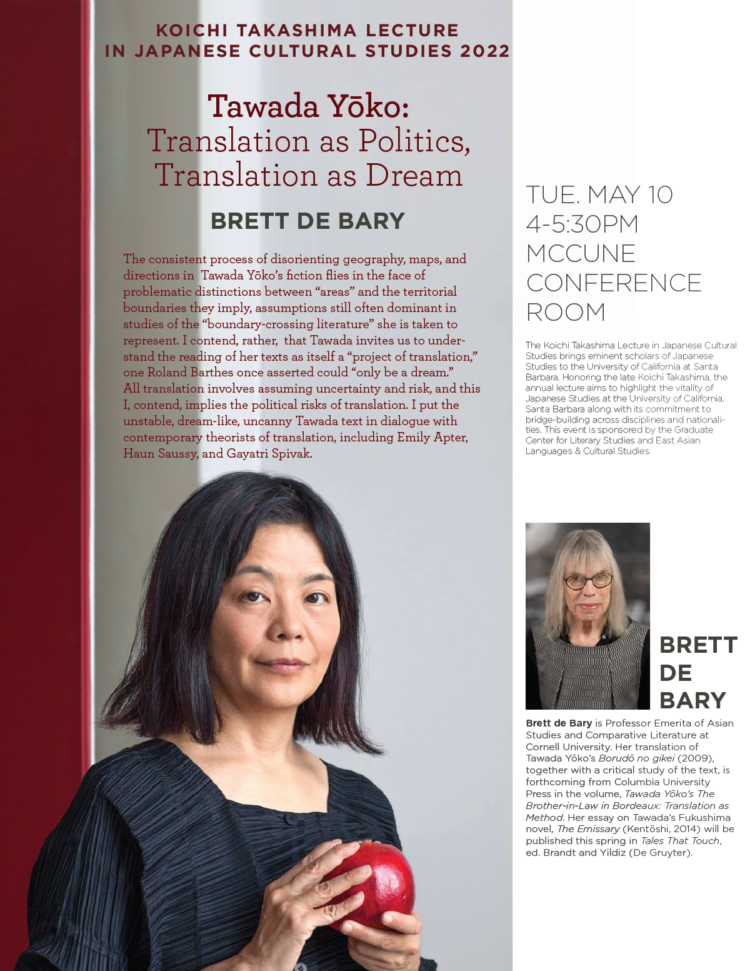
Koichi Takashima Lecture in Japanese Cultural Studies 2022: Tawada Yoko: Translation as Politics, Translation as Dream

Koichi Takashima Lecture 2022: Tawada Yōko — Translation as Politics, Translation as Dream

Koichi Takashima Lecture 2022: Tawada Yōko — Translation as Politics, Translation as Dream

The consistent process of disorienting geography, maps, and directions in Tawada Yōko’s fiction flies in the face of problematic distinctions between “areas” and the territorial boundaries they imply, assumptions still often dominant in studies of the “boundary-crossing literature” she is taken to represent. I contend, rather, that Tawada invites us to understand the reading of her texts as itself a “project of translation,” one Roland Barthes once asserted could “only be a dream.” All translation involves assuming uncertainty and risk, and this I, contend, implies the political risks of translation. I put the unstable, dream-like, uncanny Tawada text in dialogue with contemporary theorists of translation, including Emily Apter, Haun Saussy, and Gayatri Spivak.

Brett de Bary is Professor Emerita of Asian Studies and Comparative Literature at Cornell University. Her translation of Tawada Yōko’s Borudò no gikei (2009), together with a critical study of the text, is forthcoming from Columbia University Press in the volume. Tawada Yōko’s The Brother-in-Law in Bordeaux: Translation as Method.  Her essay on Tawada’s Fukushima novel, The Emissarv (Kentöshi, 2014) will be published this spring in Tales That Touch, ed. Brandt and Yildiz (De Gruyter)

TUESDAY, MAY 10, 4 — 5:30P M
UCSB:  MCCUNE CONFERENCE ROOM

Banner for Takashima Talks in Japanese Cultural Studies: The Democracy that Society Allows, Protest Sounds Japan and the US

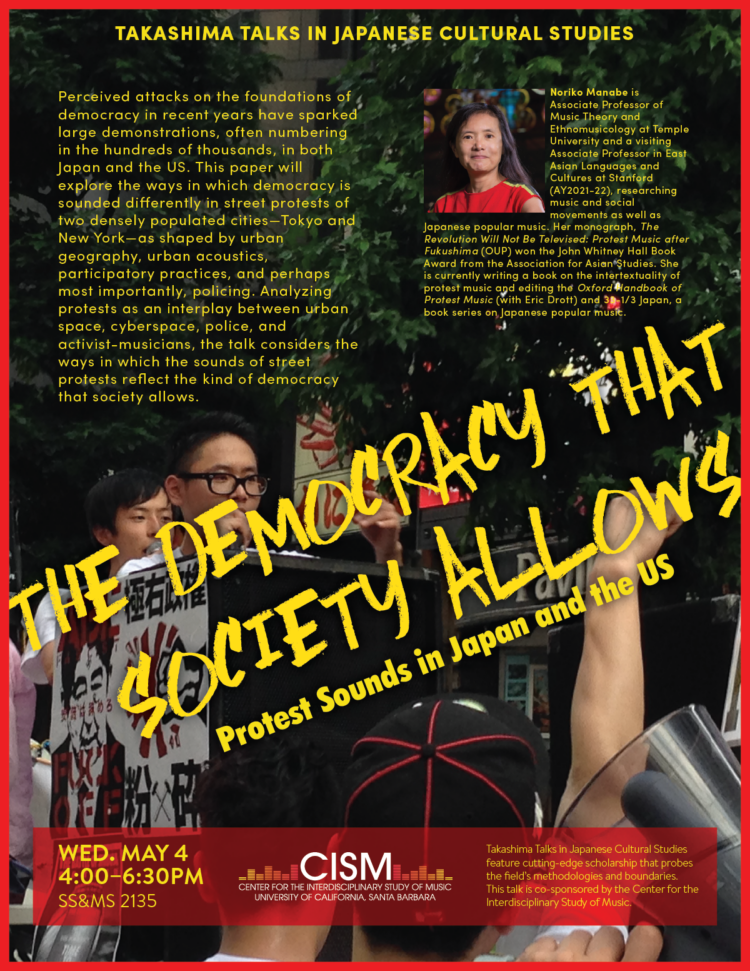
Takashima Talks: The Democracy That Society Allows — Protest Sounds in Japan and the US

Takashima Talks: The Democracy That Society Allows — Protest Sounds in Japan and the US

Perceived attacks on the foundations of democracy in recent years have sparked large demonstrations, often numbering in the hundreds of thousands, in both Japan and the US. This paper will explore the ways in which democracy is sounded differently in street protests of two densely populated cities-Tokyo and New York-as shaped by urban geography, urban acoustics, participatory practices, and perhaps most importantly, policing. Analyzing protests as an interplay between urban space, cyberspace, police, and activist-musicians, the talk considers the ways in which the sounds of street protests reflect the kind of democracy that society allows.

WEDNESDAY, MAY 4, 4:00 — 6:30 PM
UCSB Campus:  SS&MS 2135

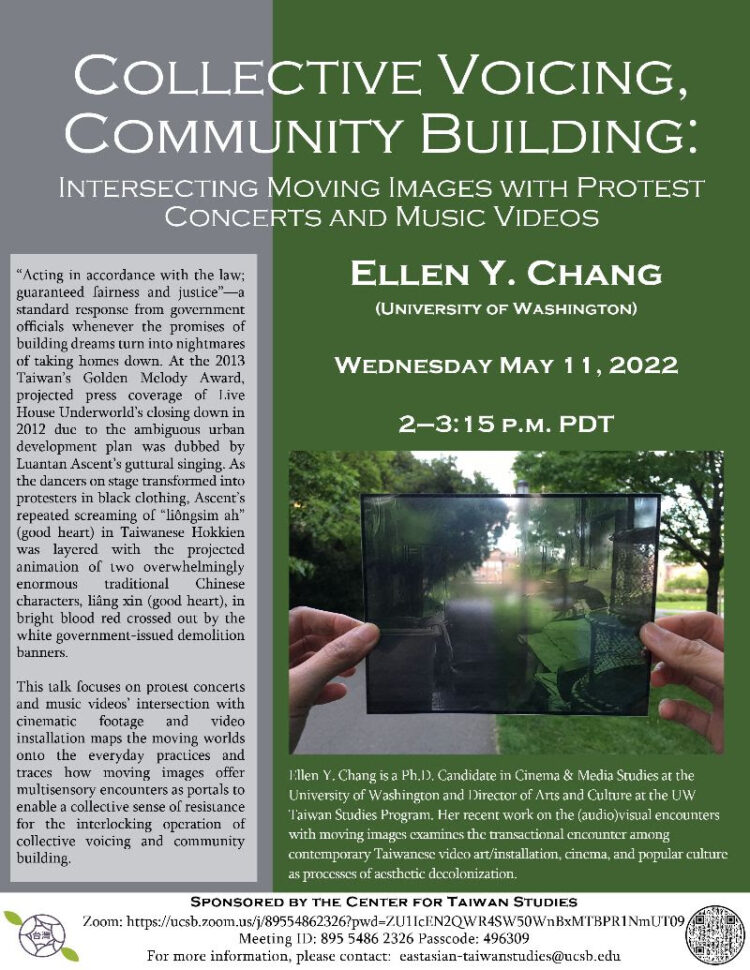
Banner for Collective Voicing, Community Building: Intersecting Moving Images with Protest, Concerts, and Music Videos

Taiwan Talks: Collective Voicing, Community Building — Intersecting Moving Images With Protest Concerts and Music Videos

ELLEN Y. CHANG, (UNIVERSITY OF WASHINGTON)

WEDNESDAY MAY 11, 2022, 2-3:15 P.M. PDT

SPONSORED BY THE CENTER FOR TAIWAN STUDIES
Zoom: https://ucsb.zoom.us/j/89554862326?pwd=Z.U1IcEN2QWR4SW50WnBxMTBPR1NmU/T09
Meeting I: 895 5486 2326 Passcode: 496309
For more information, please contact: castasian-taiwanstudies@ucsb.edu