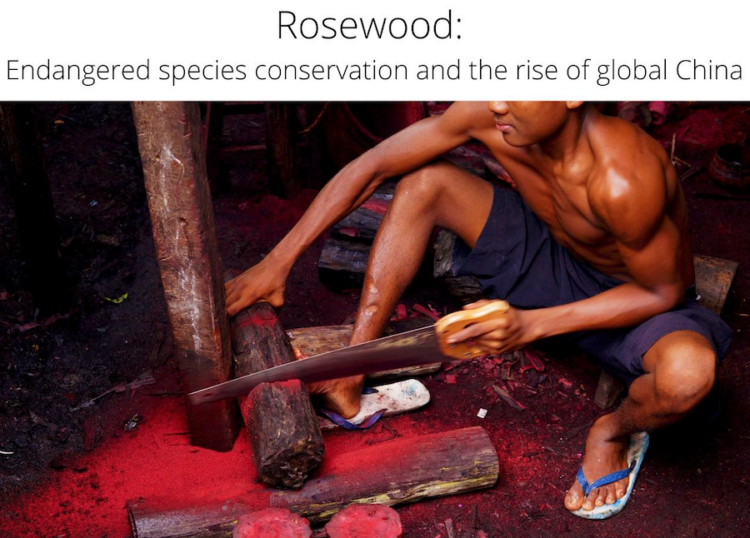
Rosewood is the world’s most trafficked endangered species by value, accounting for larger outlays than ivory, rhino horn, and big cats put together. Nearly all rosewood logs are sent to China, fueling a $26 billion market for classically styled furniture. Vast expeditions across Asia and Africa search for the majestic timber, and legions of Chinese ships sail for Madagascar, where rosewood is purchased straight from the forest. The international response has been to interdict the trade, but this misunderstands both the intent and effect of China’s appetite for rosewood, causing social and ecological damage in the process. Drawing on fieldwork in China and Madagascar, Annah Zhu upends the pieties of Western-led conservation, offering a glimpse of what environmentalism and biodiversity protection might look like in a world no longer ruled by the West.
Annah Zhu is an Assistant Professor of environmental globalization at Wageningen University in the Netherlands. She received her PhD in society and environment from the University of California, Berkeley and her Masters in environmental management from Duke University. She is a veteran of the United Nations’ Environment Program in Geneva, and a former Peace Corps volunteer in Madagascar. Her work has been published in Science, Geoforum, Political Geography, Environment International, and American Ethnologist.



 Radiation from the Fukushima nuclear disaster of 2011 broke up local communities by forcing their inhabitants into exile in locations scattered though the prefecture. In subsequent years, government compensation policy created further divisions within these ruptured communities, by providing wildly varying amounts of compensation according to the classification of danger in each district. The most handsomely compensated were those in the “hard-to-return-zones” where many households received the equivalent of US $1 million dollars or more. They have been cursed with the loss of their homeland and the lingering fear of radiation health risks, blessed with sudden wealth, then cursed again with “envy discrimination” by those less well compensated.