Kaitlyn Ugoretz’s Op-Ed on Marie Kondo Featured in Washington Post


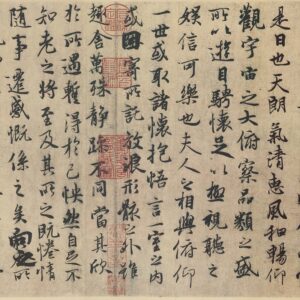
The Classical Chinese placement exam is intended for students who have already studied some Classical Chinese (文言) and would like to skip Chinese 101A and enroll directly in Chinese 101B instead. It is offered once per year, administered by Professor Thomas Mazanec. Please email Prof. Mazanec (mazanec@ucsb.edu) if you are interested in taking this exam.
The test will take place on Tuesday, September 28, 3:30–4:30pm (location to be determined). Prof. Mazanec will provide a short passage in Classical Chinese from a Master’s text (like Mencius 孟子, Zhuangzi 莊子, or Hanfeizi 韓非子) and ask students to translate it into English, focusing on the literal meaning of the words and their grammatical relationship to one another. Students may consult a paper dictionary. Prof. Mazanec will provide several copies of Paul Kroll’s A Student’s Dictionary of Classical and Medieval Chinese for reference.
If this time is impossible for you due to scheduling conflicts, please email Prof. Mazanec by Monday, September 27, to make alternative arrangements.
The application period for the placement test Fall’21 has closed. Please check back in November 2021 for the dates of the next Japanese Placement Test in Winter 2022.
If you have any questions, please contact Yoko Yamauchi (yokoy@eastasian.ucsb.edu)
〈How to prepare for the Placement Test〉
Review the materials (textbooks) of the course(s) you have taken before. We recommend to review verb and adjective conjugations as well as vocabulary and kanji. Please refer to the course description (Japanese Language Course Description) for more information about the each level of our Japanese courses. If you have a certain course you wish to start, look at the description of the course prior to the placement test. A course description indicates what you are expected to be able to do to take the course you wish to take.
“By calling something ‘good,’ you are drawing a line, saying some things are good, some are bad,” Mazanec said. “That line was drawn differently in different times and different places. There are all sorts of considerations that go into drawing that line: aesthetic, moral, social and political standards that change with time. By investigating these standards, we can learn a lot about Chinese literary history.”

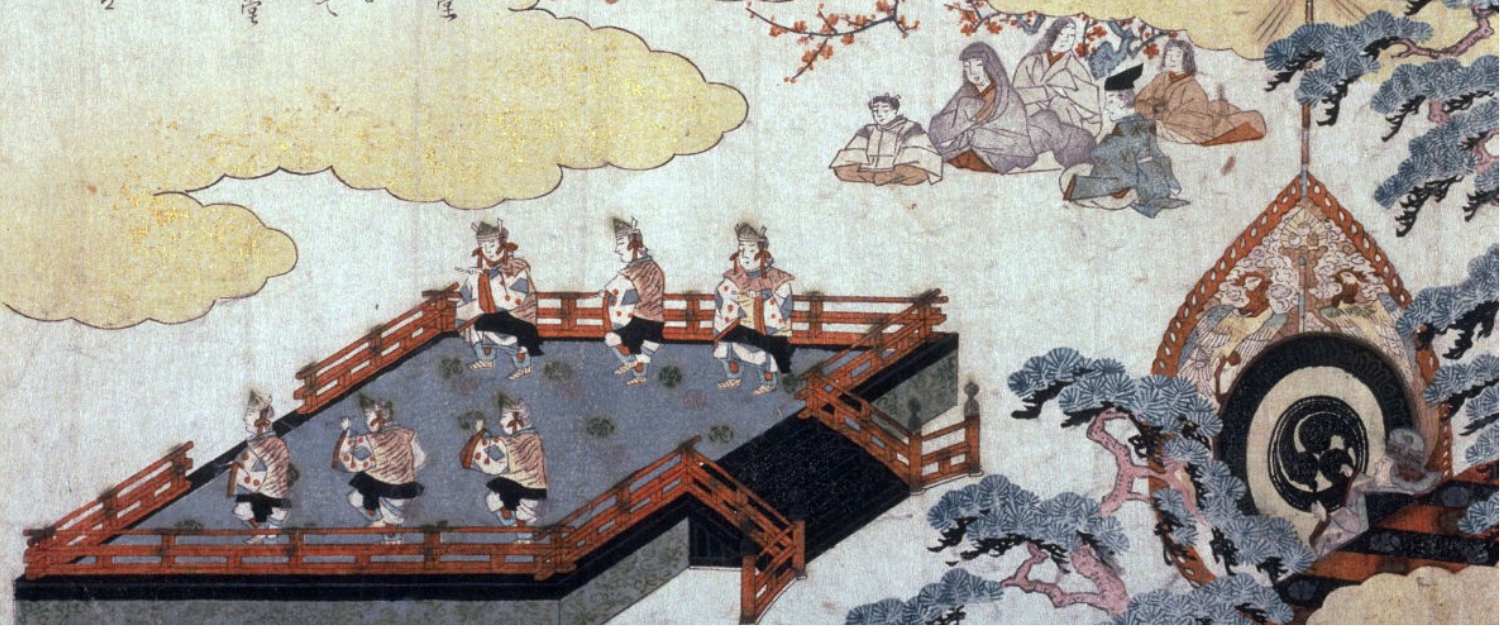
Our long-awaited Gagaku Critical Interventions Lab is going virtual!
“Gagaku: Cultural Capital, Cultural Heritage, and Cultural Identity” will discuss Gagaku (the ceremonial music of the imperial court and the main Buddhist temples and Shinto shrines in Japan) as “cultural capital” in its intellectual, political, and economic implications, as well as its transnational ramifications, for the definition of cultural heritage and the formation of cultural identity in Japan from the Edo period until today.
This Critical Interventions Lab gathers international scholars and performers engaged in cutting-edge research on the cultural history of Gagaku, with special focus on the Edo period and the modern era. Languages of the presentations and discussions are English and Japanese.
We have created an online platform that includes video presentations, texts, videos of performances, and live workshops and discussions, in the hope that this material will become an educational resource to learn about Gagaku in its various aspects.
Check out our participants, program, and resources here: http://gagaku.eastasian.ucsb.edu
This Critical Interventions Lab is organized by Fabio Rambelli (International Shinto Foundation Endowed Chair in Shinto Studies) as part of “Japanese Culture En Route: Transnational Currents and Connections in Japanese Performing Traditions” funded by a Japan Foundation Institutional Project Support grant (Ref. No. 10121178).


The Department of East Asian Languages and Cultural Studies is delighted to share the news that Prof. Suma Ikeuchi has won the prestigious 2020 Clifford Geertz Prize in Anthropology of Religion for her book, Jesus Loves Japan: Return Migration and Global Pentecostalism in a Brazilian Diaspora. Prof. Ikeuchi is also the recent winner of the 2020 Francis L.K. Hsu Book Prize, sponsored by the American Anthropological Association (AAA) Society for East Asian Anthropology. Congratulations, Prof. Ikeuchi!
The Clifford Geertz Prize in the Anthropology of Religion is awarded by the Society for the Anthropology of Religion as part of the American Anthropological Association. It seeks to encourage excellence in the anthropology of religion by recognizing an outstanding recent book in the field. The Prize is named in honor of the late Professor Clifford Geertz, in recognition of his many distinguished contributions to the anthropological study of religion. In awarding the Prize, the Society hopes to foster innovative scholarship, the integration of theory with ethnography, and the connection of the anthropology of religion to the larger world.